October is AAC Awareness Month, a time to celebrate the many ways children communicate. At Pacekids, we believe every child has something to say, and every way of saying it matters. Whether a child speaks, signs, gestures, points to a picture, or presses a button on a device, their voice deserves to be heard.
To mark the month, let’s hear from one of our own experts. Janelle Arnold, MSc., R. SLP, a Registered Speech Language Pathologist at Pacekids, shares what AAC is, how it supports children in our programs, and simple ways families can support AAC use at home and in the community.
What is AAC?
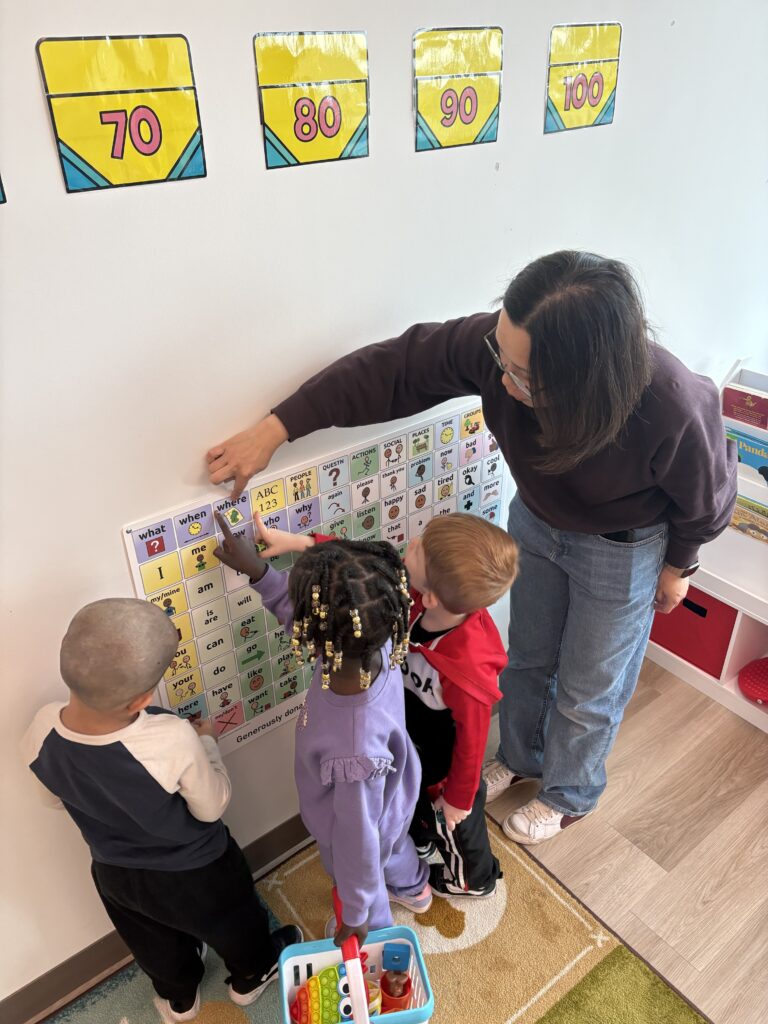
AAC stands for Augmentative and Alternative Communication. It includes any tool or method that supports a child to communicate when spoken words are not yet available or not always enough. AAC can be low-tech or high-tech.
Low-tech AAC: the communication book
A communication book is a binder filled with core words, the words we use most often. Each word appears as a picture with the written word below it. Children point to the pictures to share what they need or want to say when they do not yet have the spoken word for it.
High-tech AAC: the speech-generating device
A high-tech AAC device is a speech-generating device that uses pictures. When a child presses a button, the device says the word out loud.
Both types are wonderful tools. The right fit depends on each child, their strengths, and their family’s priorities, and our transdisciplinary team works with families to find what works best.
Why AAC matters
Communication is about so much more than asking for things. AAC can support a child to express:
- A need or a want, like “more,” “drink,” or “help”
- A comment, like sharing that something is “funny” or “big”
- A protest, like saying “stop” or “all done”
These are all things a child might otherwise find difficult to communicate. When children have a reliable way to share their thoughts, they can take part more fully in play, learning, and family life.
Ways to support AAC at home
Families are a child’s most important communication partners. Here are a few simple ways to support AAC use every day.
1. Model AAC use
Modelling means that you use your child’s device or board, just like you hope they will. Try modelling during daily activities like meals, play, getting ready, or running errands. For example, if your child is learning “more,” point to or press that word as you say it out loud during lunch.
2. Start simple
Use one or two words at a time.
3. Model without expectation
Model without expecting a response or requiring your child to use AAC. Accept any form of communication, even if it is not on the AAC device, such as signs, vocalizations, or gestures. Every attempt to communicate counts.
4. Make it a family affair
Invite siblings, grandparents, or friends to use AAC too. The more people a child sees using AAC, the more natural it becomes.
Every voice matters
AAC is not a last resort, and it does not stop a child from developing speech. It is one more way to connect, share, and be understood. At Pacekids, our Speech Language Pathologists and transdisciplinary team work alongside families to support each child’s communication goals in the classroom, at home, and in the community.
This AAC Awareness Month, we celebrate every child finding their own way to be heard.